
For an event that is so cemented in history, it can be hard to remember what a tragedy it is.
This happens often with the plane crash of Buddy Holly, Ritchie Valens and J.P. Richardson “The Big Bopper.” To lose three such influential musicians at such young ages (Holly at 22, Valens at 17 and Richardson at 28), is a tragedy that forever changed the music world, and the lives of all that knew them.
None of Holly’s family had visited the crash site in Clear Lake, Iowa, in the 65 years since, until August 1, 2024.
For Sherry Holley, the niece of Charles “Buddy” Holley (as the famous last name is originally spelled) and daughter of his brother, Larry Holley, her uncle lives in her memory.
“The last time I saw Buddy was at Christmas,” Sherry said. “And they [Buddy and his wife Maria] brought me a doll. I remember them walking into the house, to my grandmother’s house. I can remember it like it was yesterday. And they came in and he brought that doll and then I never got to see him again after that.”
In January of 1959, Buddy, Ritchie, Bopper, Dion and the Belmonts, Frankie Sardo, Waylon Jennings, Tommy Allsup and Carl Bunch set out on the 24 day Winter Dance Party Tour.
They traveled through Wisconsin, Minnesota and Iowa on the 11 stops and were set to do a show in Fargo, North Dakota, after their stop at the Surf Ballroom, but the infamous three would never make it there.
Sherry was in Clear Lake with “The Baldy Holly Band,” a group from England, who were stopping through on their way to Albert Lea, Minn., for a show before returning to the small town to play at a local bar and grill on Friday, August 2.
They went to the crash site Thursday morning.
“I heard that even Connie Valens [Ritchie’s sister], she’s never been out there and, I don’t know, I just decided to go out there,” Sherry said.

Baldy Holly is made up of Richard Smith on bass, Paul Cowan on lead guitar and vocals, Paul Grant on drums and Jamie “Baldy Holly” Bell on vocals and rhythm guitar.
Bell sports many tattoos of Buddy Holly and the Crickets down his arm and on his leg, cementing the fact that Buddy Holly is very meaningful to him. As he is to many across the pond.
“He’s bigger over there [in England],” Bell said. “When we travel around the states and mention Buddy Holly, a lot of people, especially younger people, nobody knows who Buddy Holly is. But in England, Buddy Holly is equally as famous as Elvis Presley. Still really huge.”
Bell mentioned that Holly’s music is still used in TV shows and adverts throughout England. Even the musical “Buddy: The Buddy Holly Story” began in England and ran in London’s West End for over 10 years.
“In England, even school kids will go ‘yeah, Buddy Holly,’” Bell said. “That’s really a direct correlation with The Beatles, because The Beatles were huge Buddy Holly fans. And that’s why they’re called The Beatles; they named themselves after Buddy Holly’s Crickets.”
In turn, Holly and his bandmates, made up of J.I. Allison on drums, Joe B. Mauldin on bass, and Niki Sullivan on rhythm guitar, came up with the name when playing in a warehouse.
“My dad had a tile company called the Lubbock Ceramic Tile in Lubbock, [Texas], and the nice man that owns the place now let us [Sherry and Baldy Holly] go in. And it’s the place that The Crickets were practicing, in the back of the warehouse,” Sherry said. “And that’s where they derived the name “The Crickets” because they heard crickets back there.”
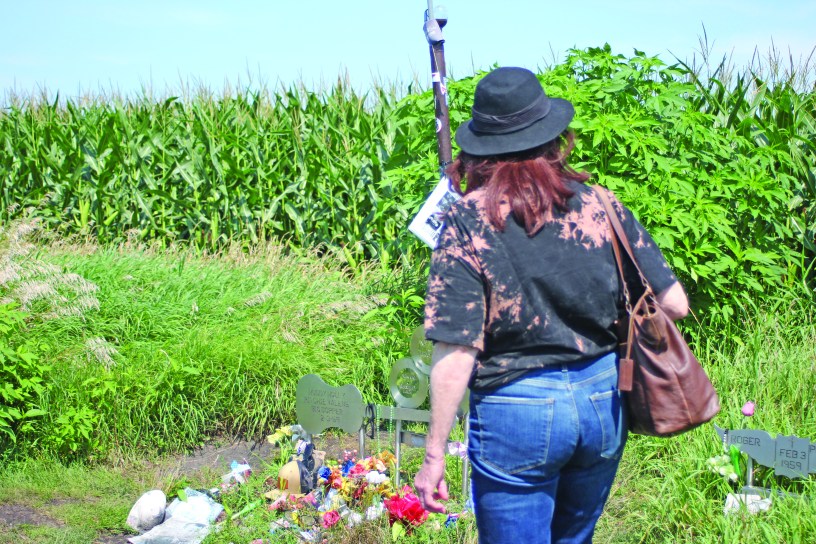
Funnily enough, the sound of crickets followed Sherry and the band as they made their way down the long path to the memorial site. Almost as if Buddy and his bandmates were greeting them.
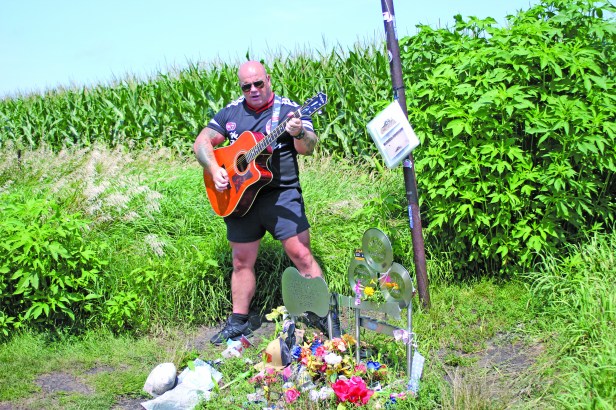
Sherry commented on how strange it was that they seemed to get louder the closer they got and, when they reached the marker, ceased completely. Leaving a peaceful silence in its wake, save for the soft strumming of an acoustic guitar they had brought along.
It was a heavy moment. To see the place where her uncle left this world rattled Sherry.
To everyone else there with her, it was a monument, a place to leave mementos, to take photos, to ponder the sadness of it all. But for Sherry, this was the place that left her with a last memory of her uncle at just seven years old.

Sherry laid some flowers beneath the stainless-steel guitar and records, alongside the other tributes left, including a few pairs of glasses, two trucker hats, flowers and many coins on the small ledge beneath the records. She stepped back after, to take it in once again and share a few hugs with the friends that surrounded her.
Despite the grief, she was able to find her voice, tearily singing a few tributes with Bell, who strummed the guitar. They sang “Amazing Grace” (a song that Sherry also sang at her mother’s burial) and “The Old Rugged Cross,” an Alan Jackson song.
There were a few more silent moments after that she stood before it became too much and she had to begin the walk back, a friend accompanying her.
Baldy Holly stayed behind to sing a few more songs, including “Learning the Game,” one of the last songs Buddy recorded before his death.
“When she says that you’re the only one she’ll ever love / Then you find that you are not the one she’s thinkin’ of
Feelin’ so sad and you’re all alone and blue / That’s when you’re learning the game.”
An impact to last long after
It’s hard to imagine what music today would be like without Buddy Holly and The Crickets, something that weighs heavily on the minds of The Baldy Holly Band, who hail from Newcastle, England.
Bell, an avid Buddy Holly fan, said, “Prior to Buddy Holly, most bands were a big band, like 40-piece orchestras, dance music like Glenn Miller. Even the Black artists, people like Little Richard, had huge bands with trumpets and big brass sections in New Orleans. But Buddy Holly was the first guy, like Nirvana, who practiced in the garage, just a guitar, drums and bass, kind of garage music. And you had all these young bands who said, ‘we can do that’ and that’s still the universal appeal. Modern rock bands all come from Buddy Holly.”
Elvis is another name that pops up around Holly’s time, but Presley had a lot of people behind him. Songwriters, musicians, producers, etc. For Buddy and the Crickets, it was just them and their guitars.
“He was in charge,” Bell said. “Buddy was writing the music, he was performing the music, he wasn’t just a singer. He was everything in one, which made groups independent.”
Back in those days, a lot of singers would have songwriters who would pen the lyrics, then give it to a good-looking guy who could hold a tune and provide a band for him to sing with. It was the original idea of rock and roll; Elvis, Chuck Berry, Jerry Lee Lewis. All those guys were front singers and a band. Then, The Crickets came along.
“[They] said ‘well, we write the song, we’ll be in charge of the recording. We will do everything.’ And it changed music. That’s how all those groups, like The Beatles and all those big groups from England, came to be, because they all followed The Crickets,” Bell said.
Buddy and The Crickets actually took a trip to England in 1958, playing at a few venues around the country.
“He was one of the first rock and roll stars,” Bell said. “So when people went to see him, they had one small amp, drums, guitar, bass. People were shocked because of the sound of an electric guitar. The newspapers at the time were sort of split, some disgusted, some wondering ‘what is this music?’ Because they were used to hearing violins and big [orchestras]. They couldn’t believe that such small unit could make such a big sound.”
One newspaper from the time reported on the band’s performance in Newcastle with the headline “How those teenagers SCREAMED.”
It said, “Three young men from Texas last night raised rock n roll from the dead in City Hall, Newcastle. And how everyone there welcomed it back…during their two concerts, their brand of powerhouse rock was lapped up by hundreds of screaming teenagers who called them back for encore after encore.”
Bell said, “All of those young guys at the time who were maybe 15-16 years old, they all bought tickets up and down the country; Liverpool, Manchester, Birmingham, London. And they all went and watched. They all then formed bands to emulate The Crickets.”
It’s funny to think that without The Crickets, the British Invasion of the ‘60s might not have happened.
Before they would ever grace the stage of “The Ed Sullivan Show,” John Lennon and Paul McCartney saw Holly play on the “Sunday Night at the London Palladium” and The Beatles would go on to emulate The Crickets’ persona (nice suits, live instruments, even tapping their feet and shaking their heads).
Of course, The Beatles reached a level of fame not possible by The Crickets. By the time The Beatles made it to America, there would’ve been no way they could’ve played at the Surf Ballroom with its 2,100 capacity.
Still, without Holly and The Crickets, there would’ve been no Beatles in the way that we know them. Maybe John Lennon would’ve been shaking his hips like Elvis instead of bouncing on his feet like Holly.
And without The Beatles and The Rolling Stones and The Kinks, etc., etc., you might not have had the explosion of rock and roll in the states that carried out well into the ‘80s, leading to the grunge revolution of the ‘90s and so on.
In a way, all stemming from a few musicians from Lubbock, Texas, who started in a warehouse.
Sherry Holley, a musician herself, said, “When he was starting out, he and the guys would sit there and listen to blues on the radio, coming out of Louisiana and Chicago. I think that’s where he got some of those guitar licks, and, of course, he had his own, but he was an admirer of those blues guys.”
If you listen to “That’ll Be The Day” you might be able to hear a guitar part that seems inspired by Fats Domino’s “Blue Monday,” but if you ask Bell, Buddy made even the simplest of guitar licks his own.
“There’s nobody that created a sound like Buddy Holly on a guitar,” he said. “Lots of people have tried, but nobody sounds like Buddy Holly. Sounds so clean.
“My guitarist, Paul [Cowan], is an incredible guitarist, he plays all the licks and his grip, but he doesn’t sound anything like Buddy. [He] had his own sound.”
Though Holly, Valens and Richardson’s careers may have been cut short, they had already made their mark. Holly produced seven top 40 hits in his few years in the spotlight, Valens is considered the first Latino rock and roll star and The Big Bopper had several hits of his own and penned others like Hank Snow’s “Beggar To A King,” George Jones’ “White Lightning” and Sonny James’ “Running Bear.”
Holly was surely the most famous of the three, at the time and debatably still.
He left behind dozens of unfinished recordings, solo transcriptions of new songs, informal jam sessions with bandmates and tapes demonstrating songs intended for other artists. The last known recordings, made in Holly’s apartment in late 1958, were his last six original songs. In June 1959, Coral Records overdubbed two of them with backing vocals by the “Ray Charles Singers” and studio musicians in an attempt to simulate the established Crickets sound. The finished tracks became the first posthumous Holly single, “Peggy Sue Got Married” / “Crying, Waiting, Hoping.” The new release was successful enough to warrant a whole album of the unreleased demos in January 1960.
The demand for Holly records was so great that his record label was able to release new Holly albums and singles for the next 10 years.
A legacy lives on: Sherry Holley talks Buddy, her music and her family.
Funny the things you remember of someone when they’re gone.
“Buddy would sit in the living room, when we had gatherings. He’d sit on the floor and he’d pull out his leather goods and start working on that, he was quite an artist of that kind also. He could make baskets, a lot of people didn’t know that. He was really artistic in that field to,” Sherry said. “He probably felt like he…that’s what I’ve heard, that he felt like he was running out of time. He had to get as much done as he could before…anything happened I guess.”
Not a lot of people are aware, but Buddy had a dream about the plane crash before it happened.
“Maria [Buddy’s wife] told me he had about it,” Sherry said. “About a fire in a plane, or some kind of a crash before it ever happened. And then Maria Elena had a similar type of dream.”
Sherry said she wished that they had listened to more of what somebody was trying to tell them.
“My dad didn’t listen to music for 10 years after [Buddy’s death],” Sherry said. “And then he did a turn around and started listening to music and started producing guys in music, you know recordings and stuff and even brought one guy to England. I guess he decided that things needed to go on.”
Her father, Larry Holley, also started working with her on her first album, a family album.
“My knees were shaking, I was a nervous wreck,” she said. “I can remember, my first recording ever, and I sounded quite different back then. It was a studio in Lubbock and we all did it. Even my brother did have put something of his on the album, a song that my dad wrote.”
It wasn’t just Buddy that caught the music bug in his family. According to Sherry Holley, many musicians have come out of the family, including herself.
“My cousin, Eddie, he’s a musician and my cousin, Ingrid, she sings blues. My favorite is blues rock,” she said. “I just got finished with an album, or we’re just about to finish it up. It’s a blues- rock album. It’s gonna have 12 of my original songs I wrote and two other people’s songs.”
At the time of the conversation, it was still being mastered but was hoped to be out before Christmas.
“My grandad, Buddy’s dad, would get all of the albums,” Sherry said. “It was amazing how that he liked so many groups for a man of his age. But I think it’s because of Buddy, he liked Buddy’s songs. He was very hip, he liked The Rolling Stones and he would give me albums like The Rolling Stones and The Searchers. Oh, he was into everything, and we’d have the best time sitting down and listening to music in his music room. It was a lot of fun. Nobody else in town knew it like he did.”
 Stereo Gaga